Key Takeaways:
- Exchanges Race Toward Full-Stack Financial Infrastructure
- Coordinated Attacks Push DeFi Security Into the Spotlight
- Anthropic's Mythos Model Raises New Cybersecurity Concerns

Exchanges Race Toward Full-Stack Financial Infrastructure
Crypto exchanges continue expanding far beyond spot trading into broader financial infrastructure. Kraken’s parent company Payward agreed to acquire digital asset derivatives platform Bitnomial in a deal valuing the company at $20 billion. Bitnomial is notably the first crypto-native platform to hold all three licenses required to operate a full-stack derivatives business in the U.S., positioning Kraken to benefit as regulators increasingly formalize crypto derivatives markets.
At the same time, Coinbase and Bybit confirmed they are exploring ways to tokenize, custody, and distribute assets including U.S. public and pre-IPO equities. The NYSE also tapped Securitize to help develop a 24/7 tokenized securities platform, reinforcing the broader trend of traditional financial infrastructure gradually migrating on-chain. Perhaps most notably, reports also emerged that both Kalshi and Polymarket are exploring perpetual futures markets, one of the most competitive sectors within crypto today. Together, these developments reinforce how exchanges and trading venues are increasingly evolving into vertically integrated financial platforms spanning trading, custody, clearing, settlement, and tokenized asset issuance.

Coordinated Attacks Push DeFi Security Into the Spotlight
DeFi security faced one of its most difficult periods in recent years following two major exploits tied to the Lazarus Group, the DPRK-linked hacking organization behind several of crypto’s largest attacks. The first involved Solana-based perpetual exchange Drift Protocol, which suffered an approximately $285 million exploit after attackers socially engineered their way into gaining unauthorized access to Drift’s Security Council. According to the team, the breach was not caused by a smart contract vulnerability, but by a months-long operational infiltration campaign that reportedly began through in-person interactions at industry conferences.
The aftermath exposed several important fault lines across the ecosystem. Tether stepped in with a recovery package worth up to $127.5 million, including a revenue-linked credit facility and ecosystem support, while Circle faced criticism for refusing to freeze stolen USDC before the funds were bridged away from Solana. The incident also accelerated new security initiatives, with Solana launching STRIDE and the Solana Incident Response Network (SIRN) to provide independent protocol evaluations, operational monitoring, and coordinated incident response support.
Another major exploit involving KelpDAO and LayerZero infrastructure resulted in roughly $290 million in losses. Attackers reportedly compromised RPC infrastructure and exploited a single-verifier bridge configuration that LayerZero had previously discouraged projects from using. The exploit created significant bad debt exposure across DeFi lending markets, with Aave emerging as one of the most impacted protocols. In response, Aave helped coordinate a broader “DeFi United” recovery effort alongside Sky, LayerZero, and other ecosystem participants to help recapitalize losses and stabilize affected protocols. More broadly, the incidents reinforced a growing reality across crypto infrastructure: the largest risks are increasingly shifting away from simple smart contract bugs toward operational security, infrastructure configuration, governance access, and human attack surfaces.

Anthropic’s Mythos Model Raises New Cybersecurity Concerns
Anthropic unveiled Claude Mythos Preview, a frontier AI model reportedly so capable at discovering and exploiting software vulnerabilities that the company decided not to release it publicly. Instead, access has been restricted to roughly 40 organizations including Apple, Microsoft, Google, Amazon, JPMorgan, and the Linux Foundation under a new defensive cybersecurity initiative called Project Glasswing.
The implications are significant. According to Anthropic, Mythos identified thousands of previously unknown vulnerabilities across major operating systems and browsers while autonomously developing working exploits at dramatically higher success rates than prior models. In one case, the model reportedly generated a complete remote root exploit with no human intervention beyond the initial prompt. More broadly, the release reinforces a growing concern across both AI and crypto: as AI systems become dramatically better at coding, they also become dramatically better at breaking software systems. For crypto, an industry built almost entirely on open-source financial infrastructure, the implications around automated exploitation, smart contract security, and adversarial AI are profound.
Distributed AI Training Continues Validating Decentralized Infrastructure
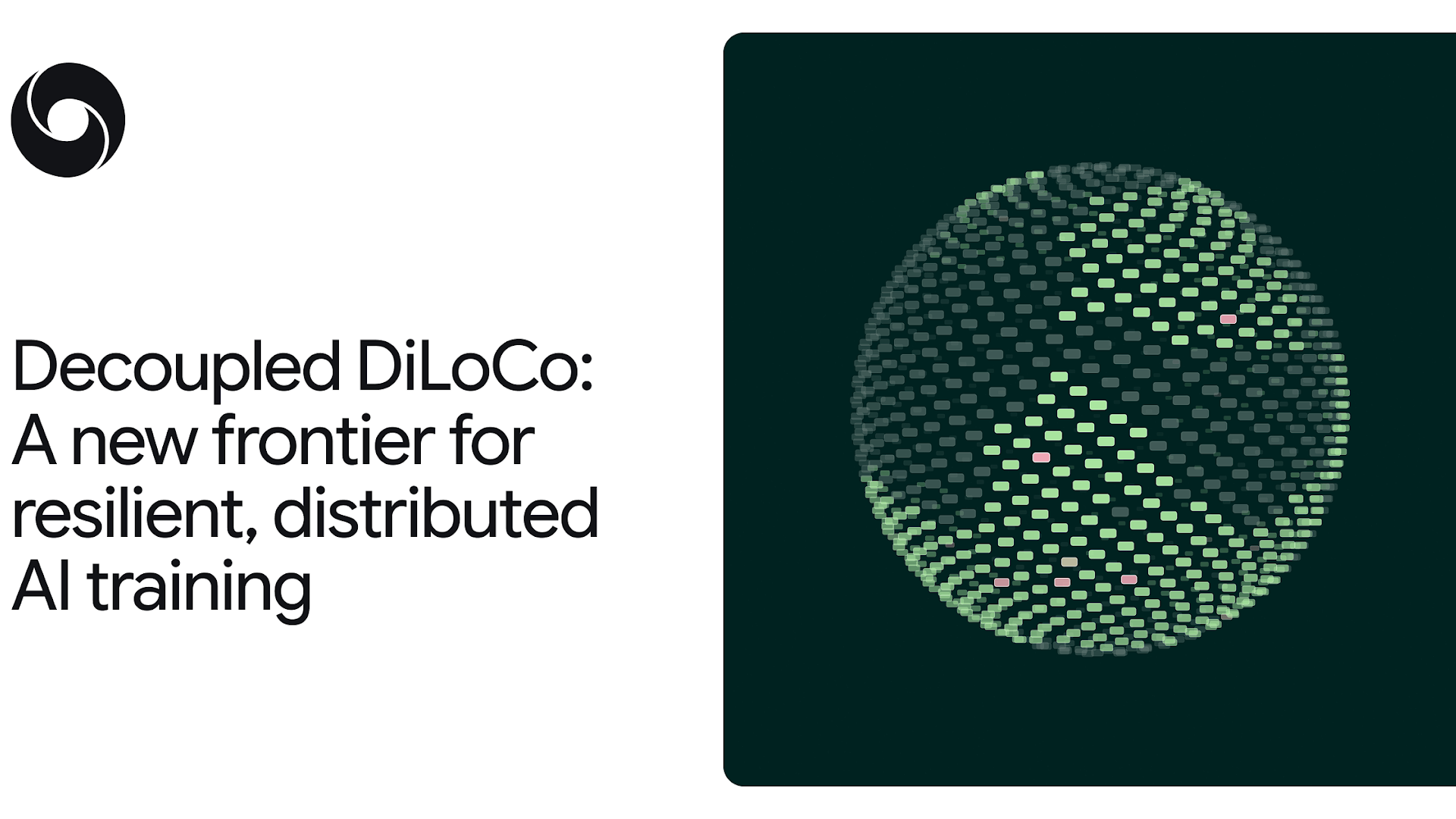
Google DeepMind released Decoupled DiLoCo, a new distributed AI training framework designed to train frontier models across geographically separated data centers connected through standard internet bandwidth rather than ultra-specialized local networking infrastructure. In testing, DeepMind reportedly trained a 12-billion parameter model across four U.S. regions more than 20 times faster than conventional distributed approaches while maintaining similar model quality.
The release comes amid growing pressure across the AI compute stack. GPU shortages continue worsening, with much of Nvidia’s upcoming Blackwell capacity already reserved and leading AI labs increasingly competing for limited compute resources. More importantly, DeepMind’s work validates an architectural direction that decentralized AI projects have been exploring for years: distributing training, inference, and data coordination across globally distributed infrastructure rather than relying exclusively on centralized hyperscale clusters.
This broader trend is increasingly driving activity across decentralized AI infrastructure networks such as Prime Intellect, Gensyn, Bittensor, and 0G Labs. Rather than focusing purely on model development, many of these projects are building modular infrastructure layers for decentralized compute, storage, inference, and data availability optimized specifically for AI workloads. While the sector still faces major challenges around coordination, verification, and incentive design, the convergence between AI scaling bottlenecks and decentralized infrastructure is becoming one of the more important emerging themes across both industries.
Disclaimer: This post has been prepared for general informational purposes only and reflects the current views of its authors. The views expressed do not necessarily represent those of Eterna Capital, its affiliates, or individuals associated with Eterna Capital, and may change without notice. Nothing contained herein constitutes or should be construed as investment, legal, accounting, or tax advice, or as a recommendation, offer, or solicitation to buy or sell any investment.