Key Takeaways:
- Base Moves Away from OP Stack to Control Its Own Stack
- BlackRock Pushes Tokenized Treasuries Further Into DeFi
- LayerZero Unveils a New Blockchain Targeting Institutional Infrastructure
Base Moves Away from OP Stack to Control Its Own Stack
Base, the layer-2 network launched by Coinbase, announced it will migrate away from the OP Stack toward a new unified technology stack built specifically for Base. Since launching in 2023, the network relied on contributions from organizations such as Optimism, Flashbots, and Paradigm. While that collaboration enabled Base to scale quickly in its early stages, the team said the growing number of dependencies across multiple repositories and partners was increasingly slowing development. By consolidating everything into a single codebase, Base aims to simplify the protocol and accelerate upgrades, targeting six smaller hard forks per year.
Beyond simplifying development, the move gives Base greater control over its long-term roadmap. By internalizing the technology stack, the network gains flexibility to introduce structural changes more quickly – whether around decentralization, compliance features, or support for tokenized assets. More broadly, the shift reflects a growing pattern in crypto infrastructure: launch quickly on shared open-source frameworks, then bring the stack in-house once scale and strategic priorities justify greater control.
BlackRock Pushes Tokenized Treasuries Further Into DeFi
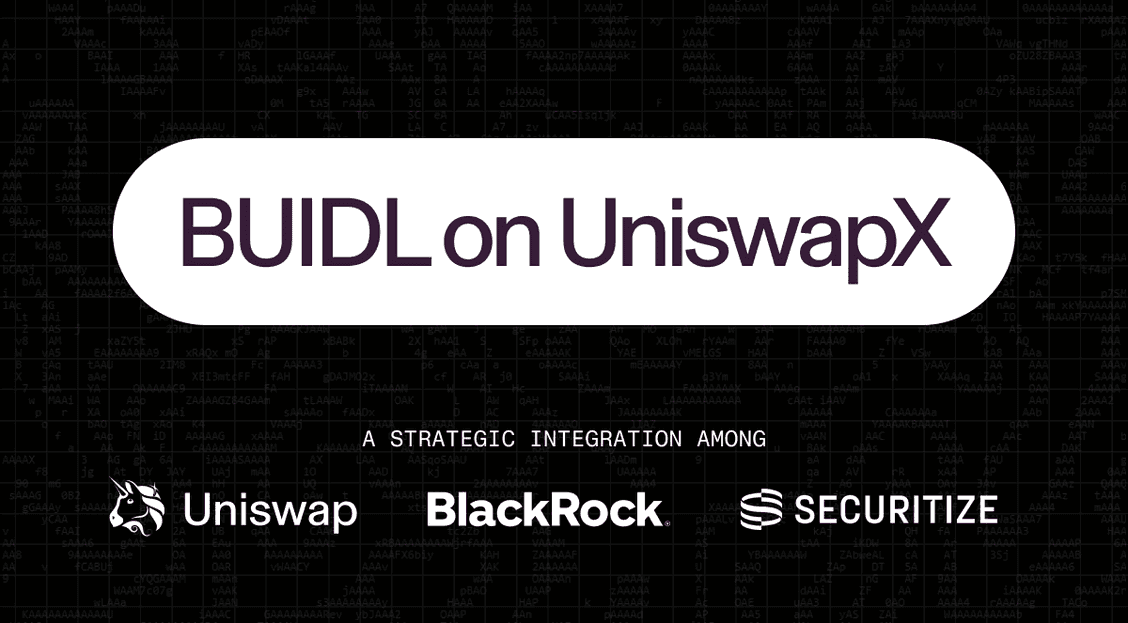
BlackRock expanded the reach of its tokenized money-market fund BUIDL by enabling trading through UniswapX, developed by Uniswap Labs. The integration, implemented with tokenization platform Securitize*, allows approved participants to trade BUIDL via a request-for-quote (RFQ) module connected to a DeFi interface. BUIDL, launched in 2024 and backed by short-dated U.S. Treasuries and repo agreements, currently holds about $2.2B in assets and exists across multiple blockchains, including Ethereum, Solana, and BNB Chain. The announcement also revealed that BlackRock acquired an undisclosed amount of UNI, briefly pushing the token’s price higher.
While the move signals growing institutional engagement with on-chain infrastructure, the setup remains tightly controlled. Participation requires KYC onboarding and whitelisted addresses, and the fund retains its $5M minimum investment, meaning typical DeFi users cannot access it. Liquidity providers are also restricted to approved market makers such as Wintermute and Flow Traders. Still, the integration marks a meaningful step toward connecting traditional financial products with DeFi liquidity rails, even if broader adoption will ultimately depend on regulatory clarity around how tokenized securities can trade on decentralized infrastructure.
*Disclaimer: Securitize is an Eterna Capital portfolio company.
LayerZero Unveils “Zero,” a New Blockchain Targeting Institutional Infrastructure
LayerZero announced plans to launch Zero, a new layer-1 network designed to support high throughput and zero-knowledge virtual machine (zkVM) execution. Positioned as infrastructure tailored for institutional use, the project highlighted launch partners including Citadel, DTCC, and ARK Invest. The architecture separates a lightweight settlement layer from application environments called “atomicity zones”, where different types of applications can run while sharing the same validator network and security model.
While the design aims to combine high performance with decentralization, it introduces a different trade-off from networks like Ethereum. Producing blocks may require significantly more resources than verifying them, meaning block production could concentrate among a smaller set of well-resourced operators. As a result, the network’s long-term decentralization will depend not only on technical design but also on governance decisions around how zones are approved and managed over time.
AI Advances Trigger Backlash as the Technology Rapidly Scales
The past few weeks saw a surge of developments across the AI sector, highlighting both rapid technological progress and growing political and societal scrutiny. OpenAI and Anthropic each released new state-of-the-art coding models within hours of one another. OpenAI’s Codex 5.3 reportedly helped develop parts of its own architecture, while Anthropic’s Opus 4.6 launch came with one of the most detailed safety disclosures yet issued by a major AI lab, warning that catastrophic outcomes remain unlikely but “not negligible.” At the same time, several researchers departed companies including Anthropic, OpenAI, and xAI, citing concerns around economic disruption, governance incentives, and the pace of autonomous AI development.
While these developments sit somewhat outside the core blockchain industry, they increasingly intersect with it in practice. Rapid improvements in AI coding tools are already reshaping how software – including crypto infrastructure and applications – is built, allowing developers to write, audit, and deploy code significantly faster. As these tools mature, they are likely to accelerate product development across the ecosystem, lowering barriers to building new protocols while raising broader questions around safety, governance, and concentration of power in AI infrastructure.
Disclaimer: this newsletter was put together for informational purposes only based on our review and analysis. This should not be construed as a solicitation, offer, or recommendation to acquire or dispose of any investment or engage in any transaction.