Key Takeaways:
- CLARITY Act Clears Major Senate Hurdle
- Wall Street's Infrastructure Begins Moving Onchain
- Prediction Markets and Pre-IPO Trading Expand Onchain
CLARITY Act Clears Major Senate Hurdle
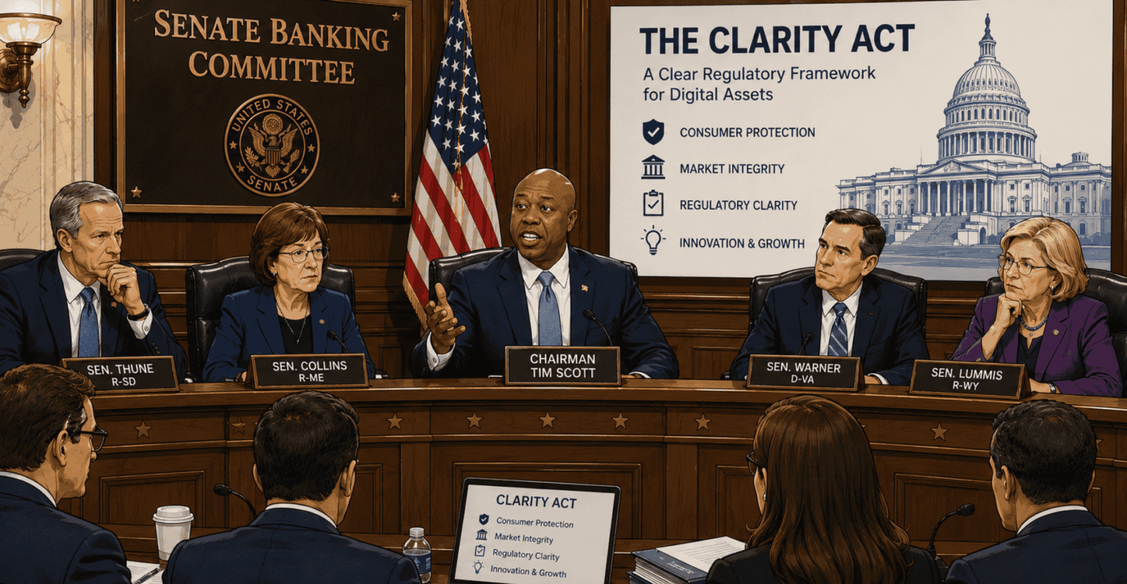
The U.S. Senate Banking Committee voted to advance the CLARITY Act, one of the most important pieces of digital asset legislation currently making its way through Washington. The measure garnered bipartisan support, improving prospects for comprehensive market structure rules becoming law. Negotiations continue regarding ethics provisions and certain DeFi-related sections, though momentum continues to build alongside the GENIUS Act from the prior year.
For much of the past decade, regulatory uncertainty has remained one of the industry's largest barriers to institutional adoption. Decision-makers, founders, and financial firms have operated amid fluctuating interpretations and competing governmental authorities. The paired legislative efforts — CLARITY and GENIUS — represent meaningful advancement toward establishing a dedicated framework for digital assets rather than forcing emerging technologies into outdated regulatory structures.
Regulatory clarity is increasingly becoming a prerequisite for tokenized securities, stablecoin adoption, and the broader convergence between traditional finance and blockchain infrastructure. Following committee action, the Senate Banking and Agriculture Committee versions require alignment before full Senate consideration, with deliberation expected this summer. Upon Senate passage, House and Senate versions would need reconciliation before presidential submission. Together, GENIUS and CLARITY would construct much of the regulatory architecture enabling subsequent phases of digital asset adoption.
Wall Street's Infrastructure Begins Moving Onchain
Two announcements this month provided perhaps the clearest indication yet that securities tokenization is moving from concept to reality. The DTCC unveiled tokenization infrastructure plans for DTC-custodied assets launching later in 2026, marking critical progress given the DTCC's foundational role in global securities settlement. Separately, Bullish announced a $4.2 billion acquisition of Equiniti, a firm serving nearly 3,000 issuers and over 20 million shareholders internationally.
Taken together, these developments suggest that key components of the securities lifecycle — issuance, ownership, transfer, settlement, and corporate actions — are increasingly being redesigned around blockchain-based infrastructure. The transformation reflects major institutions already embedded within current systems leading adoption, rather than insurgent startups aiming at systemic disruption.
Today, securities largely remain trapped within closed brokerage and custodial ecosystems. Should equities eventually become accessible as onchain assets, interaction with expanded financial applications — including lending, collateralization, and international liquidity venues — becomes feasible. Early iterations of tokenized securities will likely maintain strict permissioning and institutional governance requirements, but the foundational systems enabling a more substantial transformation of capital markets are actively being constructed.
Prediction Markets and Pre-IPO Trading Expand Onchain
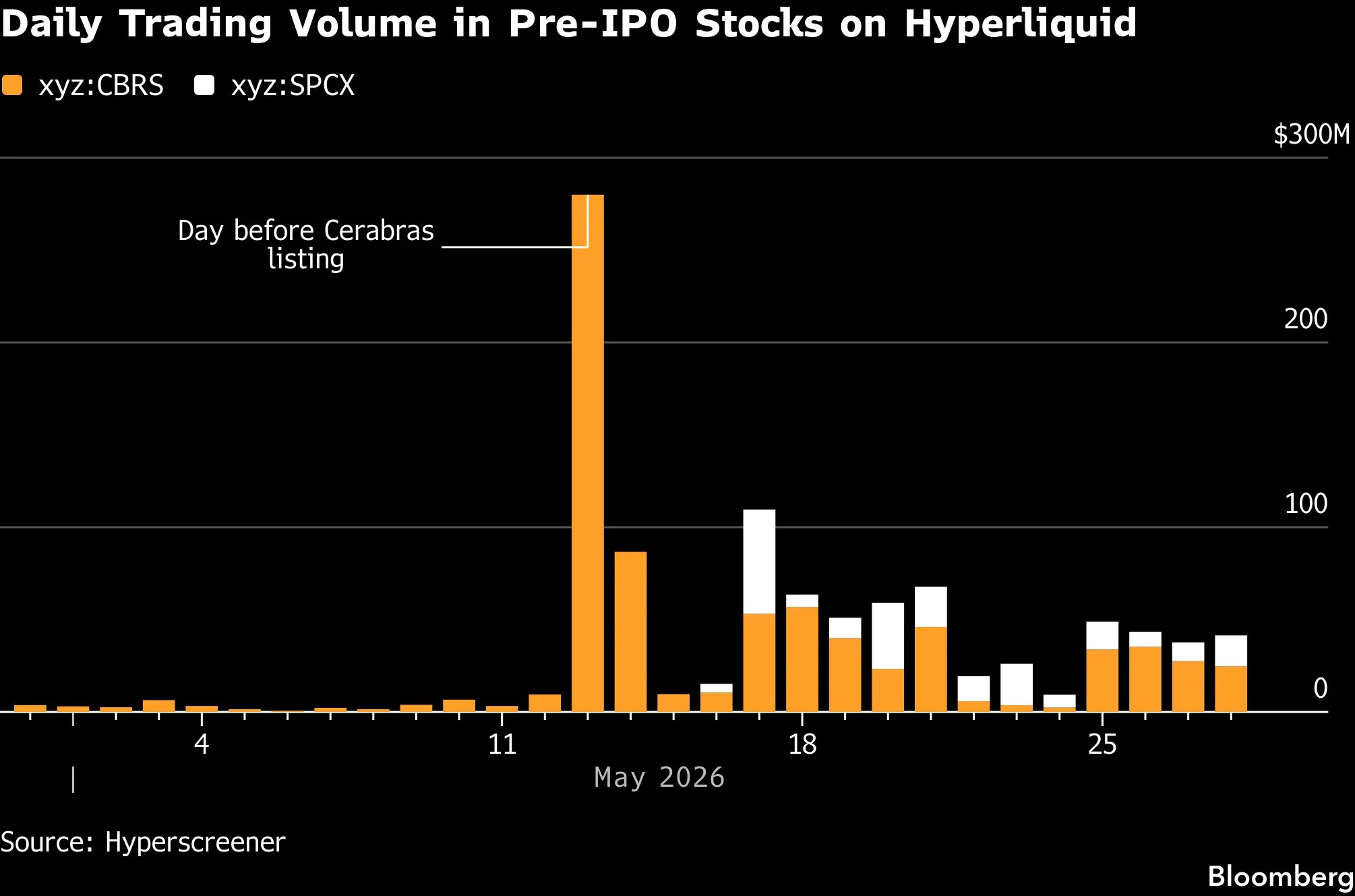
This month highlighted a broader trend that has been quietly accelerating across crypto: the transformation of virtually any event, outcome, or asset into a tradeable financial market. Hyperliquid launched HIP-4, integrating prediction markets directly into its trading infrastructure and allowing event-contract trading alongside perpetual futures and spot positions. Trade.xyz introduced SpaceX pre-IPO perpetuals, providing exposure to one of the world's most valuable private companies without requiring direct share ownership.
Platforms such as Polymarket continue expanding beyond political forecasting into private company milestones, corporate valuations, and broader economic events. The unifying element is how blockchain infrastructure is enabling liquid markets to form around assets, outcomes, and information that were previously inaccessible, illiquid, or reserved exclusively for institutional participants.
Historically, accessing private equity, venture-backed companies, or specialised event markets required accreditation, privileged relationships, or fragmented secondary markets. Crypto-native infrastructure is progressively removing these constraints. As more assets, outcomes, and information become tradeable, the opportunity may not simply be tokenizing existing markets, but creating entirely new ones.

Growing Questions Around Ethereum's Strategic Direction
Ethereum faced renewed scrutiny this month following a series of high-profile departures from the Ethereum Foundation and broader ecosystem. Multiple senior contributors left while ecosystem discussions intensified around strategic priorities, governance structures, and value capture mechanisms. Competing platforms continue strengthening their positions through focused emphasis on performance, consumer-facing applications, trading infrastructure, and artificial intelligence integration.
The challenge facing Ethereum today is fundamentally different from the challenges it faced during previous cycles. The network maintains clear dominance in stablecoins, decentralised finance, tokenised assets, and institutional blockchain deployments. However, as blockchain infrastructure matures, capital allocation increasingly reflects particular business models and application categories rather than broad general-purpose network investment.
Ethereum's next phase will likely be defined less by technical execution and more by strategic clarity. The ecosystem has established itself as settlement infrastructure for many of crypto's most prominent applications, yet the market continues to debate how ETH itself captures value as the network evolves. Despite expanding competition, Ethereum retains extraordinary strategic relevance across the digital asset landscape. The question is no longer whether Ethereum matters, but how it adapts as the industry becomes increasingly specialised and competitive.
Disclaimer: This post has been prepared for general informational purposes only and reflects the current views of its authors. The views expressed do not necessarily represent those of Eterna Capital, its affiliates, or individuals associated with Eterna Capital, and may change without notice. Nothing contained herein constitutes or should be construed as investment, legal, accounting, or tax advice, or as a recommendation, offer, or solicitation to buy or sell any investment. This material should not be relied upon to evaluate the merits of any investment decision. Eterna Capital makes no representation or warranty, express or implied, regarding the accuracy, completeness, or reliability of the information contained herein. All liability in connection with this material and any reliance thereon is expressly disclaimed.